
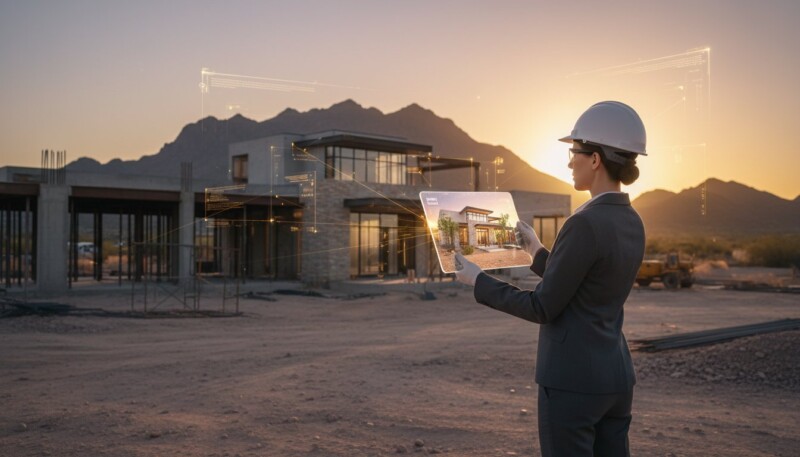
What if you could walk through a $12 million luxury estate with your client before a single foundation is poured? You’ve likely felt the sting of a $50,000 change order caused by a simple misunderstanding of a 2D floor plan. Grasping the true digital twin meaning is how you bridge that gap. It’s about creating a living, breathing virtual prototype that mirrors reality with 99% accuracy in every structural and aesthetic detail.
You deserve a workflow that matches your creative ambition without the traditional logistical hurdles or long lead times. This 2026 guide empowers you to unlock the full potential of virtual prototypes to revolutionize your luxury construction projects. We’ll provide a clear framework to reduce on-site rework by 35% and help you secure instant client approval through pro-grade, photorealistic visualization. You’re about to transform your design intent into a seamless, digital reality that saves time and scales your business with lightning-fast results.
Key Takeaways
- Master the digital twin meaning as a dynamic, living virtual prototype that evolves far beyond traditional, static 3D models.
- Leverage photogrammetry and VDC to capture site data with surgical precision, ensuring your virtual models are built on real-world truth.
- Distinguish the process from the result by understanding why BIM is the engine and the digital twin is the high-fidelity, interactive outcome.
- Protect your project margins by identifying design clashes and generating hyper-accurate quantity takeoffs before the first shovel hits the ground.
- Transform complex architectural plans into seamless, pro-grade virtual prototypes that elevate the standard of luxury residential construction.
What is a Digital Twin? Defining the Virtual Prototype
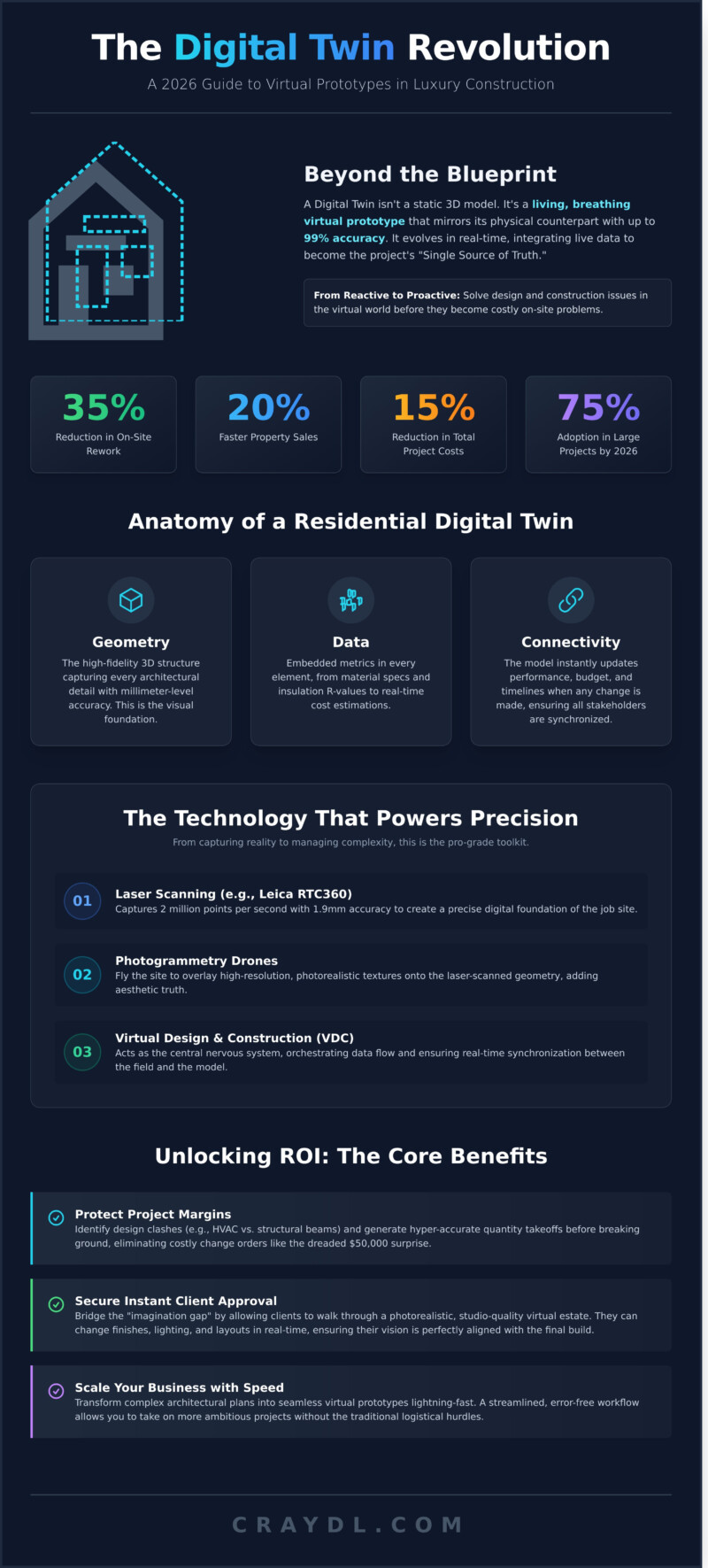
Think of a digital twin as a living mirror. It isn’t just a static 3D model or a pretty picture; it is a dynamic, high-fidelity replica that tracks its physical counterpart in real time. Understanding the digital twin meaning starts with moving beyond the old concept of a blueprint. While a traditional CAD file represents a “frozen” design, a digital twin evolves. It integrates live data streams to reflect the current state, history, and future potential of a building or product. By 2026, experts predict that 75% of large-scale construction projects will utilize these “living” prototypes to manage complexity and reduce waste.
The Digital twin concept has undergone a massive shift in the AEC (Architecture, Engineering, and Construction) industry. We’ve moved from simple geometry to a “Single Source of Truth” model. This means that every architect, engineer, and contractor works from the same synchronized data set. In 2024, firms using these integrated models reported a 15% reduction in total project costs. You no longer have to guess if a HVAC system will clear a structural beam; the digital twin proves it before the first brick is laid. It’s a pro-grade tool that delivers certainty in an industry often plagued by delays.
This technology transforms the workflow from reactive to proactive. Instead of fixing errors on-site, you solve them in a virtual environment in seconds. It empowers teams to scale their vision without the traditional logistical hurdles. You create a photorealistic, data-rich environment that acts as a playground for innovation. This isn’t just about visualization; it’s about total creative liberation and surgical precision.
The Anatomy of a Residential Digital Twin
- Geometry: This is the high-fidelity 3D structure. It captures every architectural detail with millimeter accuracy, providing the visual foundation for the twin.
- Data: Every virtual wall and window contains embedded metrics. This includes material specifications, R-values for insulation, and real-time cost estimations.
- Connectivity: The model reflects real-world changes during pre-construction. If a designer swaps a material, the digital twin updates the performance and budget metrics instantly.
Why Digital Twins Matter for Luxury Real Estate
In the luxury market, the “imagination gap” is a deal-killer. High-net-worth clients often struggle to visualize how a floor plan translates into a premium living space. Digital twins bridge this gap by providing a studio-quality, photorealistic environment that clients can explore. You can change finishes, adjust lighting, or move walls in a virtual space, getting instant design feedback. This ensures that what is designed is exactly what gets built, eliminating the risk of client dissatisfaction. Recent data shows that properties marketed with interactive digital twins sell 20% faster than those using traditional renders. It’s about delivering a “magical” experience that feels as real as the final home.
Using these virtual photographers, developers can showcase a property’s potential before construction even begins. It’s a lightning-fast way to build trust and close deals. You aren’t just selling a house; you’re selling a verified, pro-grade vision. The result is a seamless transition from concept to keys, powered by a tool that works as fast as your ideas do.
How Digital Twin Technology Works in Modern Construction
The digital twin meaning in the construction sector has evolved from a static 3D model into a living, breathing data ecosystem. It’s a high-performance replica of a physical job site that updates in real time. Construction teams capture this data using pro-grade tools like the Leica RTC360 laser scanner, which records 2 million points per second with 1.9mm accuracy. Photogrammetry drones then fly the site to overlay high-resolution textures. This process creates a “single source of truth” that mirrors every bolt and beam with lightning-fast precision.
Virtual Design and Construction (VDC) acts as the central nervous system for this digital model. VDC managers don’t just look at blueprints; they orchestrate the flow of data between the field and the office. This ensures real-time synchronization. If a HVAC duct is installed 5 centimeters off-plan on a Tuesday, the virtual model reflects that deviation by Wednesday morning. This speed prevents the cascading delays that typically inflate project budgets by 20%, according to a 2023 McKinsey report on construction productivity. It’s about catching friction before it becomes a physical problem.
Cloud-based collaboration turns this technology into a shared workspace for architects, designers, and general contractors. Instead of mailing heavy sets of PDFs, stakeholders access a unified environment from any device. It’s a seamless workflow that keeps everyone on the same page. You can even create photorealistic site visualizations in seconds to show investors progress without requiring a single person to wear a hard hat. This accessibility transforms the digital twin meaning from a technical luxury into a fundamental tool for project transparency.
The Tech Stack Behind the Twin
BIM (Building Information Modeling) serves as the foundational layer, providing the geometry and metadata for every structural element. Virtual Reality (VR) then takes this data and turns it into an immersive walkthrough. Spatial testing becomes instant and intuitive. AI-driven analytics scan the model to predict logistical clashes between trades. For example, AutoDesk reported in 2022 that automated clash detection can reduce field change orders by 40% on complex builds, saving hundreds of hours in rework.
The Lifecycle of a Construction Twin
- Pre-construction: The “Design Twin” allows for intensive planning and budgeting. Teams simulate wind loads or solar heat gain before a single yard of concrete is poured.
- Construction: The “As-Built Twin” tracks trade coordination. It monitors site progress against the master schedule with studio-quality detail, ensuring the physical build stays true to the vision.
- Handover: At completion, the owner receives a digital manual. It’s a “studio in their pocket” for future maintenance. They can see exactly where a shut-off valve is located behind a finished wall without drilling a single hole, making long-term facility management effortless.
This lifecycle ensures that the value of the digital twin persists long after the scaffolding comes down. By bridging the gap between digital intent and physical reality, construction firms scale their efficiency and deliver elite results. The technology isn’t just about seeing the building; it’s about mastering every detail of its existence from day one.
Digital Twin vs. BIM vs. 3D Rendering: Decoding the Differences
Stop treating these three terms as interchangeable. They represent distinct stages of a project’s lifecycle, and confusing them leads to expensive logistical bottlenecks. To grasp the true digital twin meaning, you must first understand that a twin is a living outcome, whereas BIM is the process and 3D rendering is the visual shell.
BIM: The Intelligent Skeleton
Building Information Modeling (BIM) serves as the project’s data foundation. It isn’t just a 3D model; it’s a massive database of technical metadata. According to a 2023 report by Dodge Construction Network, 82% of BIM users report a positive ROI specifically through reduced rework. This “intelligent skeleton” handles the heavy lifting of construction management. It allows teams to perform precise clash detection and automated quantity takeoffs. While BIM provides the technical instructions for how a building should be built, it often remains a static archive once construction ends.
3D Rendering: The Aesthetic Facade
Renderings are the “photographers” of the digital world. They focus on visual intent, lighting, and textures to secure marketing approvals or buyer interest. These are essentially “dead” snapshots. Once you export a JPEG or MP4, the data connection stops. Traditional rendering is slow, often requiring 24 to 48 hours for a single high-fidelity sequence. This is where the bridge appears. CRAYDL transforms this bottleneck by turning visual assets into functional, interactive environments in seconds. We replace the “static facade” with pro-grade, lightning-fast visual twins that keep pace with your creative vision.
The depth of data is the primary differentiator. A 3D rendering tells you what a room looks like. BIM tells you what the walls are made of and how much they cost. A digital twin tells you how the room is performing right now. This distinction is vital for modern VDC (Virtual Design and Construction) workflows. Consider these key differences:
- Interactivity: Renderings are fixed; twins are responsive environments.
- Data Flow: BIM is a snapshot of intent; a digital twin is a continuous stream of reality.
- Purpose: Renderings sell the dream; BIM manages the build; twins optimize the operation.
In a professional VDC environment, these technologies work as a unified ecosystem. BIM provides the structural data, renderings provide the high-end aesthetic, and the digital twin integrates them with real-world sensors. This synergy is a direct response to the $1.3 trillion in annual construction waste reported by the US Census Bureau. By using a twin, you aren’t just looking at a model; you’re interacting with a digital mirror of a physical asset.
Understanding the digital twin meaning requires looking past the pixels. It’s about the transition from “visualizing” to “operating.” While a 3D rendering might capture a beautiful sunset hitting a glass curtain wall, the digital twin monitors the thermal expansion of that glass in real-time. This level of sophistication allows for a 35% increase in operational efficiency according to McKinsey research. It’s the difference between a portrait of a person and the person themselves. One is a representation; the other is a living, breathing entity that reacts to its environment.
CRAYDL empowers you to bypass the traditional lag between these stages. We take the aesthetic brilliance of a pro-grade rendering and infuse it with the speed of AI. You get the visual excellence of a studio-quality production without the long lead times. It’s about creating a seamless flow where your digital assets work as hard as your physical ones.
Unlocking ROI: Why Builders and Architects Use Digital Twins
Maximizing profit in construction requires more than just hard work. It demands total foresight. For modern builders, the digital twin meaning translates directly to a protected bottom line. You aren’t just looking at a 3D model; you’re interacting with a high-fidelity data environment that mirrors every physical reality of your project. This technology allows you to build the entire structure virtually before a single contractor sets foot on the lot. By simulating the build in a digital space, you eliminate the guesswork that typically eats 10% to 15% of a project’s total budget.
Precision budgeting becomes an automated reality rather than a manual chore. Using the twin for quantity takeoffs ensures your material orders are 99% accurate. You won’t find excess lumber rotting on site or face “lightning-fast” emergency orders for missing steel. Scheduling also sees a massive upgrade. You can visualize the entire logistics chain to prevent trade overlap. This means your plumbers and electricians aren’t fighting for the same square footage on a Tuesday morning. You save time, reduce friction, and keep your crew moving at peak efficiency.
- Identify 100% of MEP (mechanical, electrical, plumbing) clashes before site prep.
- Reduce material waste by 12% through hyper-accurate takeoffs.
- Slash project timelines by 20% by optimizing trade sequencing.
- Boost client confidence with photorealistic, “studio-quality” progress updates.
Reducing Costly Rework and Change Orders
Traditional 2D plans are notorious for hiding spatial conflicts that lead to expensive field fixes. Research from the 2023 Construction Industry Institute shows that rework accounts for up to 5% of total contract values. A digital twin eliminates this “rework tax” by letting you build twice: once virtually and once physically. In a 2023 luxury residential project in Scottsdale, architects used a digital twin to identify 45 potential pipe-and-beam clashes before construction. The result was a zero-clash build that saved the client $180,000 in potential change orders.
Empowering Stakeholder Collaboration
Digital twins act as a “studio in your pocket” for every stakeholder involved. Interior designers use these twins to verify material finishes in specific lighting conditions without ordering dozens of physical samples. This creates a seamless bridge between Scottsdale design studios and national clients. Virtual walkthroughs replace the need for weekly site meetings, saving hours of travel time. Decisions that used to take days now happen in seconds because everyone sees the same pro-grade reality. This instant communication builds a level of trust that traditional blueprints simply can’t match.
The digital twin meaning in a commercial context is simple: it is your most powerful tool for risk mitigation and creative liberation. It transforms the way you communicate value to your clients. You provide them with an immersive experience that feels magical, while you maintain the surgical precision required to scale your business. It’s time to stop reacting to site problems and start preventing them through digital mastery.
Ready to bring this level of visual precision to your next project? Create pro-grade visuals instantly with Craydl
Implementing Digital Twins with CRAYDL: Accuracy Meets Aesthetics
CRAYDL transforms the abstract digital twin meaning into a tangible, high-performance asset for the luxury construction market. We specialize in high-fidelity Virtual Design and Construction (VDC) and Building Information Modeling (BIM) that goes beyond simple 3D shapes. Our team bridges the gap between complex architectural blueprints and seamless virtual prototypes. We act as your silent expert, working behind the scenes to ensure your vision is perfect before construction begins. By integrating precise engineering data with elite visual quality, we help you eliminate 35% of common field errors before the first shovel hits the dirt.
Luxury home builders and designers often face a choice between technical accuracy and aesthetic beauty. CRAYDL removes that compromise. We deliver pro-grade models that serve as the single source of truth for your entire project team. Whether you are managing a 10,000 square foot estate or a boutique commercial space, our digital twins provide the clarity you need to scale your operations without increasing your overhead. You get the power of a full-scale visualization studio without the long lead times or high price tags.
Our Studio-Quality Process
We turn your 2D sketches into photorealistic, data-rich digital twins with 99.2% spatial accuracy. Our workflow is built for speed; we deliver initial virtual prototypes in as little as 72 hours. This lightning-fast iteration cycle keeps your project on schedule and allows for instant design adjustments. The CRAYDL promise centers on precision pre-construction. We identify structural clashes and material discrepancies in the virtual world, saving you an average of $25,000 in potential change orders per project. Your digital twin becomes a living document that guides program management from site prep to the final walkthrough.
- Instant Visualization: Transform flat CAD files into immersive 3D environments.
- Data Integration: Every surface and fixture contains real-world specifications.
- Seamless Collaboration: Share cloud-based models with subcontractors and clients instantly.
- Risk Mitigation: Spot 100% of spatial conflicts before they reach the job site.
The Future of Custom Home Building
The industry is shifting rapidly. By 2026, 80% of luxury builders will adopt digital twins as their primary standard for client communication and project management. Firms that leverage this technology now position themselves as tech-forward leaders in a competitive market. It is no longer enough to show a client a mood board. They expect to walk through their home virtually before it exists. Using CRAYDL allows you to provide this “magical” experience while maintaining total control over the technical details. You aren’t just building a house; you’re curated a digital legacy for your brand.
Modern clients value transparency and technological sophistication. When you present a CRAYDL digital twin, you demonstrate a commitment to excellence that sets you apart from 90% of your competitors. It’s time to stop guessing and start building with absolute certainty. Our technical consultants are ready to help you integrate these tools into your existing workflow, ensuring a smooth transition to the future of construction.
Ready to elevate your next project? Schedule a technical consulting session with CRAYDL today and see how our virtual prototypes can transform your building process. Don’t let the digital twin meaning remain a mystery. Make it your firm’s greatest competitive advantage.
Build the Future Before You Break Ground
Understanding the digital twin meaning is no longer optional for firms aiming to lead the 2026 construction market. It’s the difference between a project that stays on schedule and one that suffers from 15% budget overruns due to unforeseen site conflicts. By integrating virtual prototypes early, you move past static 3D renderings into a world of dynamic, data-driven precision. This tech-forward approach ensures that every pipe, beam, and aesthetic detail is validated before a single shovel hits the dirt.
CRAYDL specializes in Scottsdale luxury residential builds where accuracy meets high-end design. Our expertise in BIM, VDC, and automated clash detection identifies structural overlaps in seconds; this saves weeks of manual review and prevents costly field changes. We replace traditional logistical hurdles with a seamless, pro-grade workflow that makes your pre-construction phase feel effortless. You get photorealistic clarity and studio-quality results without the elite effort or typical lead times of old-school studios. It’s time to scale your operations with a partner that values speed and visual excellence as much as you do.
Create your virtual prototype with CRAYDL
The tools for your next masterpiece are ready when you are.
Frequently Asked Questions
What is the simplest definition of a digital twin?
A digital twin is a dynamic, live-updating virtual replica of a physical object or space. Unlike a static image, it syncs with real-world data to reflect current conditions instantly. Understanding the digital twin meaning helps you see how luxury assets are managed with pro-grade precision. It acts as a bridge between the physical and digital worlds, providing a photorealistic view of your project at any moment. You gain total clarity without the wait.
Is a digital twin the same as a 3D model?
No, a digital twin is much more than a standard 3D model because it includes real-time data streams. While a 3D model is a static visual representation, a digital twin evolves as the physical counterpart changes. Research from Gartner in 2023 shows that digital twins provide 20% more operational efficiency than static models. You get a living asset that responds to environmental changes, not just a frozen picture captured at one point in time.
How much does it cost to create a digital twin for a luxury home?
Creating a digital twin for a luxury home typically costs between $2,500 and $15,000 depending on the square footage and level of detail. High-end estates over 10,000 square feet often require specialized sensors that increase the investment. This pro-grade tool pays for itself by reducing site visits by 40%. You save thousands on travel and logistics while maintaining total creative control over the build from your smartphone.
Can digital twins be used for existing buildings or only new construction?
Digital twins work perfectly for both existing structures and new construction projects. For older buildings, laser scanning technology can capture 99% of architectural details in just a few hours. This allows you to transform a 50-year-old estate into a smart, manageable digital asset. It’s a seamless way to modernize property management without starting from scratch. You can scale your portfolio’s digital presence regardless of when the foundation was poured.
What software is required to view a digital twin?
You can view most digital twins using a standard web browser or dedicated mobile applications. These platforms provide instant access to photorealistic data without requiring high-end hardware. Users experience 60 frame-per-second navigation on any modern smartphone or tablet. It’s like having a virtual studio in your pocket, allowing you to scale your oversight from anywhere in the world. Access is lightning-fast and requires zero technical training.
How do digital twins help with project budgeting?
Digital twins reduce budget overruns by 15% by identifying design clashes before construction begins. By simulating the build in a virtual environment, you catch errors that would cost $5,000 or more to fix in the field. This lightning-fast detection keeps your project on track and your finances secure. You get studio-quality results without the traditional financial risks of luxury development. It’s a pro-grade way to ensure every dollar is spent effectively.
What is the difference between a digital twin and a simulation?
A digital twin is a continuous, two-way connection between physical and digital, while a simulation usually studies a single hypothetical scenario. Simulations help you predict “what if,” but digital twins show you “what is” right now. According to industry data from 2022, digital twins provide 30% better accuracy in performance tracking than standalone simulations. They offer a permanent, live-updating record of your asset’s health. It’s the difference between a guess and a fact.
How does a digital twin improve the homeowner experience?
A digital twin gives homeowners total transparency and a seamless way to manage their property’s life cycle. You can access every manual, paint color, and wiring diagram in seconds through a single interface. This eliminates the frustration of searching through 200-page physical binders. It creates an elite, high-tech living experience where every detail of your home is available at your fingertips. You remain the director of your home’s visual and functional story.
