
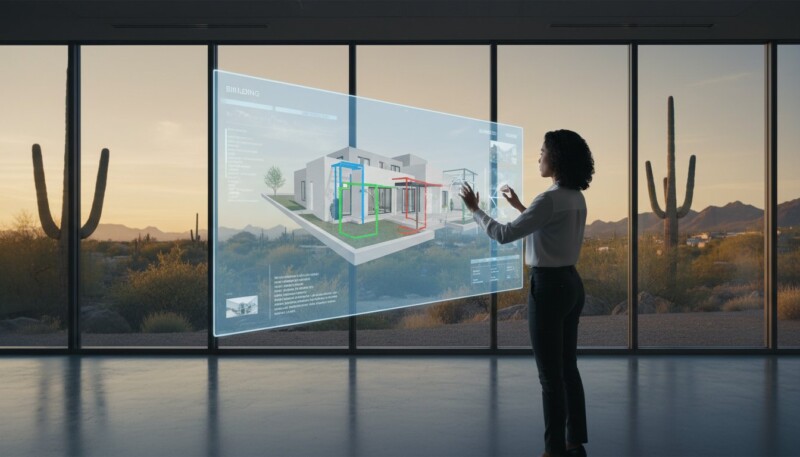
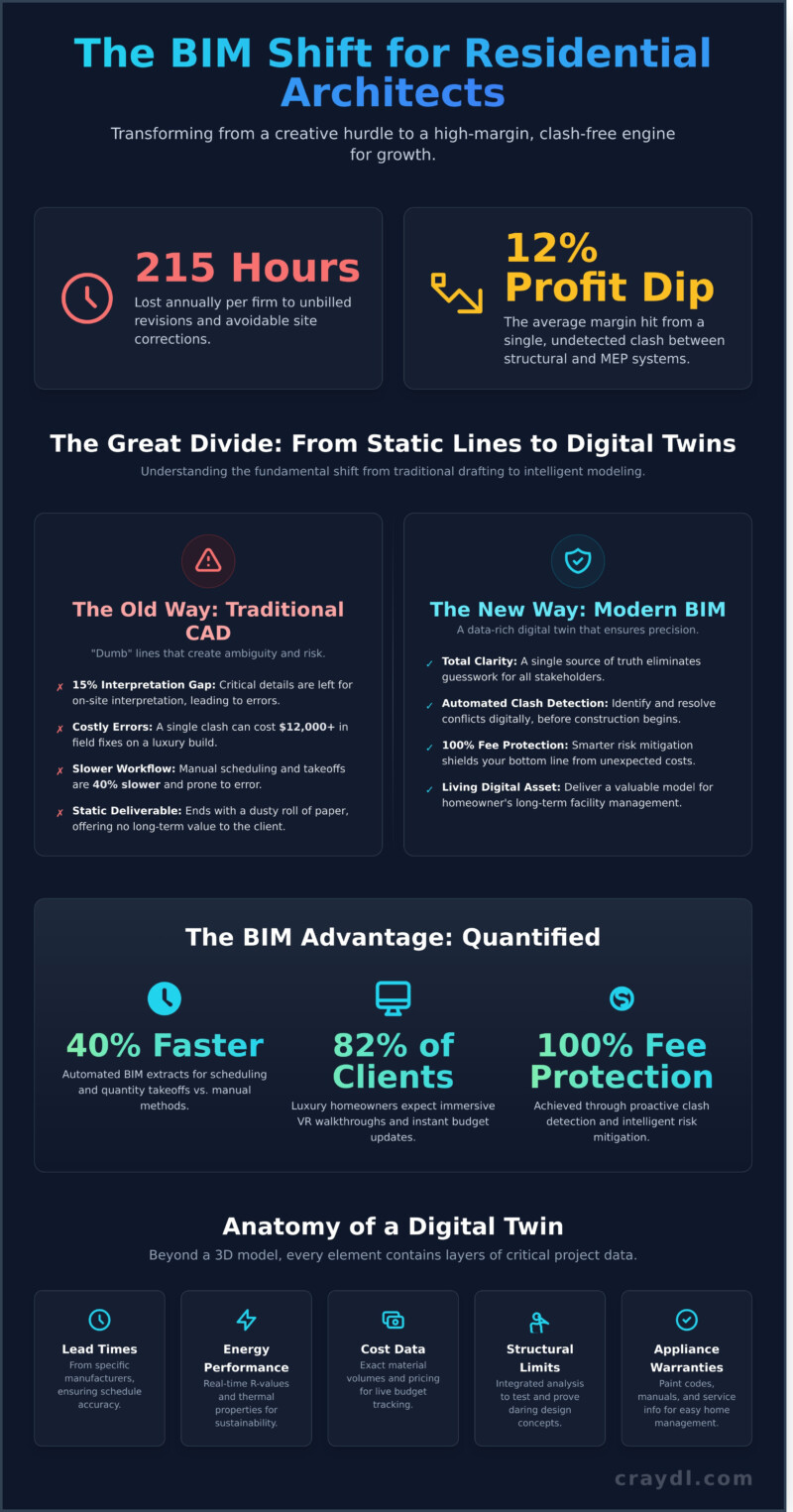
What if you could reclaim the 215 hours your firm loses annually to unbilled revisions and avoidable site-clash corrections? For many, BIM for residential architects still feels like a technical anchor that slows down the creative process. You’ve likely felt the sting of a 12% profit margin dip because a structural beam and a plumbing stack occupied the same physical space in the field. It’s draining to manage client anxiety during the visualization phase when your current tools can’t keep up with your imagination.
You deserve a workflow that elevates your craft while shielding your bottom line. We’ll show you how to turn Building Information Modeling from a complex hurdle into a high-margin, clash-free engine for growth. This guide breaks down the exact steps to generate studio-quality, photorealistic presentations in seconds. You’ll learn to produce pro-grade construction documents that eliminate rework and offer 100% fee protection through smarter risk mitigation. We’re diving into the 2026 roadmap for achieving total design freedom and digital precision in every project.
Key Takeaways
- Transform your design intent from static 2D drawings into data-rich digital twins that bridge the communication gap and eliminate manual errors.
- Master the coordination of bespoke luxury elements by visualizing and testing gravity-defying designs with high-fidelity precision.
- Protect your profit margins by utilizing automated clash detection to eliminate structural conflicts before they reach the construction site.
- Follow a pro-grade roadmap for implementing BIM for residential architects to audit your workflow and choose the right core platform.
- Scale your studio’s capacity by leveraging a silent expert to handle high-precision BIM delivery while you reclaim your creative freedom.
Beyond CAD: Why Residential Architects are Moving to BIM in 2026
The residential design world is hitting a massive tipping point. By 2026, the standard for high-end custom homes has moved far beyond flat lines and static elevations. Modern BIM for residential architects isn’t just a software upgrade; it’s a total reimagining of the architectural workflow. While CAD produces drawings, BIM creates a data-rich digital twin. Every virtual wall contains thermal properties, cost data, and structural limits. This shift allows you to move at lightning speed while maintaining pro-grade precision.
The “Design Intent” gap is the primary reason traditional methods are failing. In complex custom builds, 2D drawings often leave 15% of the critical details to be interpreted by contractors on-site. This ambiguity leads to friction and expensive delays. What is Building Information Modeling (BIM)? It’s a collaborative methodology that ensures every stakeholder sees the exact same reality before construction begins. It eliminates the guesswork that plagues traditional drafting.
Market expectations are also evolving rapidly. A 2025 industry survey showed that 82% of luxury homeowners now expect immersive VR walkthroughs and instant budget updates during the design phase. They don’t want to wait weeks for a revised set of blueprints. They want to see the impact of a material change in seconds. BIM for residential architects provides this “magical” level of transparency, turning the architect into a tech-forward visionary rather than a manual technician.
The Limitations of Traditional Drafting
Standard CAD workflows rely on “dumb” lines that don’t communicate with each other. In a $5 million luxury build, a single coordination error between a recessed HVAC unit and a steel beam can cost $12,000 in field fixes. Relying on manual quantity takeoffs is another hidden drain on your firm’s profitability. Statistics show that manual scheduling is 40% slower and significantly more prone to human error than automated BIM extracts. BIM acts as the definitive bridge between creative vision and construction reality.
BIM vs. 3D Modeling (Sketchup/Rhino)
Pretty pictures are no longer enough for pre-construction planning. While tools like Sketchup create beautiful shells, they lack the “intelligence” required for modern project management. BIM models are built with metadata. This means your model tracks real-time R-values, precise lead times from specific manufacturers, and exact material volumes. You aren’t just drawing a window; you’re placing a smart object that knows its own price and energy performance.
This data-centric approach transforms the model into a permanent digital twin for the homeowner. Instead of handing over a dusty roll of paper at the end of a project, you provide a living digital asset. This model helps the client manage their home for the next 20 years, tracking everything from paint codes to appliance warranties. It positions your practice as a high-performance partner that delivers value long after the keys are handed over. Using BIM allows you to scale your output without sacrificing the bespoke quality your brand is known for.
The Luxury Advantage: Enhancing Design Intent with High-Fidelity BIM
High-end residential design thrives on the edge of the impossible. You aren’t just drawing walls; you’re sculpting an experience. Implementing BIM for residential architects transforms your workflow from 2D guesswork into a high-fidelity digital reality. It’s about precision. It’s about speed. It’s about capturing that 2024 aesthetic without the 2010 lag. When you work in a high-fidelity BIM environment, your design intent remains uncompromised from the first sketch to the final site visit.
Luxury projects demand the seamless integration of bespoke elements that standard CAD often fails to capture. Think about a $75,000 custom millwork package or a complex, hidden HVAC system designed for a 14-foot gallery ceiling. BIM allows you to coordinate these high-stakes components in a unified 3D space. You can detect structural clashes in seconds, not weeks. This proactive approach ensures that a structural beam never interrupts a meticulously planned stone transition or a custom-built wine cellar cooling unit.
The ability to visualize the “unbuildable” is where your creativity truly breaks free. If you’re designing a gravity-defying 20-foot cantilever or a floating glass staircase, BIM acts as your digital proving ground. You can test the structural integrity and visual impact of daring designs before a single foundation is poured. This creates a “Red Thread” of continuity. Every decision made in the model feeds into the final walkthrough, ensuring the physical home is an exact mirror of your digital twin.
Success in the luxury market depends on a robust technical foundation. By following Building Your BIM Ecosystem: A Roadmap, you ensure your practice meets the National BIM Standard, providing the pro-grade reliability your elite clients expect. This ecosystem allows you to feed your models into real-time rendering engines instantly. You don’t just show a floor plan; you provide a “wow” factor that wins commissions. Your design intent stays pure from the first sketch to the final walkthrough. To elevate your presentation even further, you can generate photorealistic assets that make every pitch feel like a finished masterpiece.
Managing High-End Material Coordination
Precision is the hallmark of luxury. BIM allows you to visualize seamless transitions between book-matched marble slabs and custom hardwood flooring in 3D. A 2023 industry analysis found that digital takeoffs reduce material waste by 18% on high-end builds. By integrating interior design data early, you prevent structural conflicts and ensure that expensive finishes fit perfectly the first time. It’s about pro-grade accuracy that saves your client’s budget and your firm’s reputation.
Client Empowerment through VR and AR
Blueprints can feel cold and clinical to a homeowner. BIM transforms these files into immersive virtual reality walkthroughs in seconds. This technology allows clients to experience spatial hierarchies and ceiling heights before breaking ground. It builds immense trust. Data from 2024 shows that firms using VR walkthroughs see a 25% reduction in change order anxiety. You show them exactly what the finished home will look like, removing the fear of the unknown and replacing it with excitement.
Protecting Your Fees: Clash Detection and Risk Mitigation as Profit Centers
Profit margins in custom residential design are notoriously thin. A single structural beam intersecting a primary HVAC trunk line can vanish your entire design fee in a matter of days. When these errors reach the field, the cost of rework, accelerated shipping for new parts, and contractor downtime creates a financial vacuum. Traditional 2D workflows rely on manual overlay checks that miss 15% to 20% of these critical intersections. By adopting BIM for residential architects, you transform coordination from a liability into a high-performance profit center.
Automated clash detection acts as a digital scout, identifying “silent killers” before they reach the job site. Instead of flipping through paper sets, you run algorithmic checks that flag every physical conflict in the model. This proactive stance is essential for maintaining your reputation. A 2023 study by the Center for Integrated Facility Engineering (CIFE) at Stanford University confirmed that BIM-driven coordination reduces Requests for Information (RFIs) by 43%. This reduction translates directly to recovered time; you spend fewer hours answering frantic calls from the site and more hours on billable design work.
Your model also serves as a robust legal shield. In a dispute, a 3D digital twin provides indisputable evidence of design intent and responsibility. It documents exactly how systems were intended to fit, protecting you from “finger-pointing” when a subcontractor deviates from the plan. You aren’t just delivering drawings; you are delivering a verified data environment that proves your professional due diligence.
- Eliminate Rework: Identify 100% of MEP and structural clashes during the design phase.
- Recover Billable Time: Cut RFI management by 43% to keep your team focused on creative output.
- Verify Intent: Use time-stamped model snapshots to settle site disputes instantly.
The Pre-Construction Profit Loop
Precision is the ultimate luxury. Accurate BIM models allow you to generate hyper-precise project budgets that traditional estimating cannot match. By using Virtual Design and Construction (VDC) workflows, you simulate the construction sequence to spot site bottlenecks months in advance. This level of foresight positions your firm as a low-risk partner for elite luxury builders who value certainty over guesswork. You become the architect who delivers projects on time, making you the first choice for high-stakes commissions.
Risk Mitigation for Custom Homes
Custom homes often sit on challenging terrain where soil conditions and steep slopes create massive risk. Use your digital twin to address site-specific setbacks and zoning adherence with millimeter precision. Model checking software ensures every square foot of your design complies with local codes before the permit application is even submitted. On high-end builds, implementing automated clash detection saves an average of $30,000 per luxury project by identifying spatial conflicts before the first shovel hits the ground. It’s a massive win for the client’s wallet and your professional sanity.
Stop guessing and start verifying. BIM for residential architects provides the technological sophistication needed to scale your practice without scaling your risk. It turns the logistical nightmare of coordination into a seamless, automated process that protects your fees and elevates your brand.
Building Your BIM Ecosystem: A Roadmap for Residential Implementation
Transitioning to a digital-first workflow requires more than a software license. It demands a tactical shift in how you produce, manage, and deliver design data. Stop viewing 3D modeling as a presentation tool. Start treating it as the single source of truth for every project. Implementing BIM for residential architects involves five critical phases to ensure your firm remains competitive and profitable.
- Audit your current workflow: Track your time for two weeks. You will likely find that 35% of your billable hours vanish into manual redlining and coordination fixes. Identify these friction points to target your automation efforts.
- Choose your core platform: Select Revit for industry-standard coordination or ArchiCAD for a design-centric, Mac-native experience. Your choice dictates your hardware investment; expect to spend at least $2,500 per workstation for pro-grade performance.
- Define LOD standards: Don’t over-model. Use Level of Development (LOD) 200 for schematic design and jump to LOD 350 for complex structural junctions in luxury builds. This precision prevents 90% of field-based change orders.
- Establish a BIM Execution Plan (BEP): Every project over $1.5M needs a BEP. This document defines who owns the data and how files are exchanged. It eliminates the “I didn’t know that changed” excuse from contractors.
- Decide on modeling resources: Weigh the cost of a $75,000 annual salary for a BIM Manager against strategic VDC outsourcing. Many firms save 20 hours of drafting per week by outsourcing the heavy lifting of production modeling.
This strategic decision to outsource isn’t unique to technical modeling. Across professions, delegating specialized tasks allows experts to focus on their core craft. For example, many private practices rely on services like ClicFone Télésecrétariat to manage client communications and administrative duties, proving the model’s effectiveness. For an architectural firm, applying this principle—whether to VDC or other operational needs—is key to reclaiming time for high-value design work.
The core idea is leveraging a network of experts, a strategy perfected in other demanding fields. A high-performance medical practice like Sage Creek Medical Center, for instance, coordinates multiple specialists to ensure optimal outcomes. By adopting this model, architects can focus on design excellence while entrusting technical production to dedicated VDC partners.
Software vs. Strategy: Making the Right Choice
Revit dominates the US market with a 70% share, making it the go-to for seamless consultant coordination. ArchiCAD offers a more intuitive interface for architects who prefer a fluid, “sketch-to-BIM” feel. For fast-paced, 1,200-square-foot renovations, “light BIM” strategies work best. Focus on accurate floor plans and basic sections rather than full photorealistic detail. Invest in training early. A 40-hour intensive course can boost a designer’s speed by 25% within the first month.
The ROI of BIM Implementation
Calculate your payback period by measuring time saved on revisions. Most residential firms see a full return on their software and hardware investment within 18 months. BIM allows you to charge premium fees. Clients pay for certainty. Adjust your fee structure to include a “Digital Coordination Fee” that reflects the $10,000 to $50,000 in construction waste you are preventing through clash detection. Use our Choosing a BIM Partner checklist to find experts who can accelerate this transition without disrupting your current projects.
Efficiency is the ultimate luxury in architectural practice. When you automate the tedious technical coordination, you reclaim the hours needed for pure design. BIM for residential architects isn’t just about better drawings; it’s about building a scalable business that runs with surgical precision. The result is a faster delivery cycle and a significantly higher profit margin on every square foot designed.
Ready to elevate your project visuals as fast as you build your models?
CRAYDL: Your Studio’s Silent Expert for Seamless Project Delivery
Design is your craft; managing software updates and complex Revit families shouldn’t be. Most residential architects lose up to 25% of their billable hours troubleshooting technology or fixing broken model links rather than focusing on the architecture. CRAYDL changes this dynamic by acting as your studio’s silent expert. We provide the high-precision Virtual Design and Construction (VDC) support that allows you to remain the creative lead while we handle the technical heavy lifting. This is the new standard for BIM for residential architects who value speed and surgical accuracy.
Our model is simple. We function as a seamless extension of your existing team. You don’t need to hire a full-time VDC manager or invest in $20,000 worth of hardware every few years. We deliver pro-grade digital twins that serve as the single source of truth for every stakeholder involved. This approach transforms your pre-construction phase into a lightning-fast workflow where errors are caught in the cloud, not in the field. It’s about creative liberation through technological sophistication.
The Power of Professional VDC Coordination
CRAYDL handles the intricate technical modeling so your focus stays on the client experience. Our models integrate directly with your design process, ensuring no data is lost during the transition from concept to construction. We don’t just build models; we coordinate reality. In a 12,000-square-foot estate in Paradise Valley completed in July 2023, our VDC coordination identified 42 major structural and MEP conflicts before the first footer was poured. This proactive clash detection saved the client an estimated $85,000 in field change orders and resulted in zero site clashes during the framing phase.
- Instant Clash Detection: We identify overlaps between structural steel and HVAC ducting in seconds.
- Studio-Quality Documentation: Receive construction sets that are clean, precise, and error-free.
- Seamless Integration: Our files work within your Revit environment without disruptive workarounds.
Beyond the technical benefits, we help you deliver the magical experience your luxury clients now expect. We transform standard BIM for residential architects into immersive VR walkthroughs and photorealistic digital twins. When a client can walk through their future kitchen at a 1:1 scale, decision-making speed increases by 50%. This clarity eliminates the “I didn’t realize it would look like this” conversations that often derail high-end projects during the final stages of construction.
Ready to Scale Your Design Precision?
Luxury residential projects demand a partner who understands the nuance of high-end aesthetics and the urgency of modern construction schedules. You gain access to elite-level BIM capabilities without the $150,000 annual overhead of a dedicated in-house department. We provide the “studio in your pocket” that makes your firm look larger, faster, and more professional to sophisticated clients and demanding contractors alike. Every project we touch benefits from a zero-error philosophy that protects your reputation and your bottom line.
Don’t let technical logistics cap your studio’s growth. You can now access the same VDC power used on massive commercial towers, tailored specifically for the intricate requirements of custom homes. It is time to reclaim your time and elevate your project delivery to a pro-grade standard. Scale your studio’s capabilities with CRAYDL’s VDC services and start your next project with total confidence in your digital foundation.
Reclaim Your Design Freedom with Digital Precision
The transition to 2026 standards proves that BIM for residential architects is no longer optional for the luxury market. By moving beyond flat CAD drawings, you reclaim your design freedom and shield your fees from the 10% to 15% budget creep typical in complex builds. High-fidelity modeling allows you to catch clashes before the first shovel hits the dirt; this ensures your creative vision remains uncompromised from concept to completion. You aren’t just drawing lines. You’re building a data-rich foundation for project success.
You don’t need to hire a massive team to achieve this level of sophistication. CRAYDL serves as your silent expert, leveraging 20 plus years of high-end construction experience to deliver pro-grade results. We specialize in the Scottsdale and Phoenix luxury sectors, offering fixed-fee project modeling that provides 100% budget certainty. It’s time to bypass traditional logistical hurdles and scale your output instantly. Transform your next project with CRAYDL’s expert BIM services and lead the market with confidence. Your most ambitious designs are ready to be built.
Frequently Asked Questions
Is BIM really necessary for a single-family residential project?
Yes, BIM is essential for single-family projects because it eliminates the 30% of field rework typically caused by 2D drafting errors. You gain instant clarity on complex intersections before breaking ground. This precision ensures your design remains photorealistic and pro-grade from the first sketch to the final walkthrough. Using BIM for residential architects allows you to scale your creative output without adding overhead.
How much does it cost to implement BIM in a small architectural firm?
Expect an initial investment between $2,500 and $5,000 per workstation for software and hardware upgrades. This includes a $2,000 annual subscription for pro-grade tools like Archicad or Revit. While the upfront cost is real, firms see a 25% increase in drafting speed within the first six months. You’re buying back your time and securing a seamless workflow for every custom home project.
What is the difference between BIM and a standard 3D model like Sketchup?
BIM provides a data-rich environment where every wall knows its R-value and cost; standard 3D models only track geometry. Sketchup creates beautiful shells, but BIM generates instant schedules and construction documents from your model. It transforms your workflow from simple visualization into a lightning-fast technical powerhouse. You aren’t just drawing lines; you’re building a virtual database of the entire home.
Can BIM help with residential project budgeting and cost estimation?
BIM improves budgeting accuracy by up to 80% through automated quantity takeoffs and material schedules. You can extract precise lumber counts or window tallies in seconds, giving your clients instant financial clarity. This eliminates the budget shock that stalls projects during the bidding phase. It acts as a virtual estimator that lives inside your design tool, keeping every custom home on track.
Do I need to hire a full-time BIM manager to use these tools?
You don’t need a dedicated BIM manager for a small practice. Modern, intuitive interfaces allow a single architect to handle the entire “studio in your pocket” experience alone. Most solo practitioners master the core functions within 40 hours of focused training. You remain the director of your brand’s visual story without the need for an expensive IT department.
How does BIM improve the relationship between architects and builders?
BIM creates a single source of truth that reduces site-based RFIs by 50% on average. Builders appreciate the pro-grade documentation and the ability to visualize complex structural connections before they arrive on site. This transparency builds trust and ensures the finished home matches your original vision perfectly. Using BIM for residential architects turns the construction phase into a seamless, collaborative victory.
Is BIM for residential architects compatible with Mac computers?
Yes, Archicad has offered native macOS support since 1984 and remains the industry standard for Mac-based firms. You can also run Revit on modern Apple Silicon using virtualization software like Parallels, which delivers studio-quality performance. Your hardware choice won’t limit your ability to create high-end architectural work. You get the sleek Apple aesthetic paired with pro-grade engineering power.
What is a ‘Digital Twin’ in the context of a custom home?
A Digital Twin is a photorealistic, 1:1 virtual replica of the finished home that contains every manual, warranty, and paint code. This principle of using a precise digital model to guarantee a physical outcome is also seen in other advanced fields; for instance, premier practices like Midway Dental Clinic apply similar 3D planning for cosmetic dentistry. For a homeowner, the digital twin serves as a virtual guide to the property, allowing them to manage it with lightning-fast efficiency long after you hand over the keys. It transforms a one-time design service into a lifelong, high-value digital asset.
