
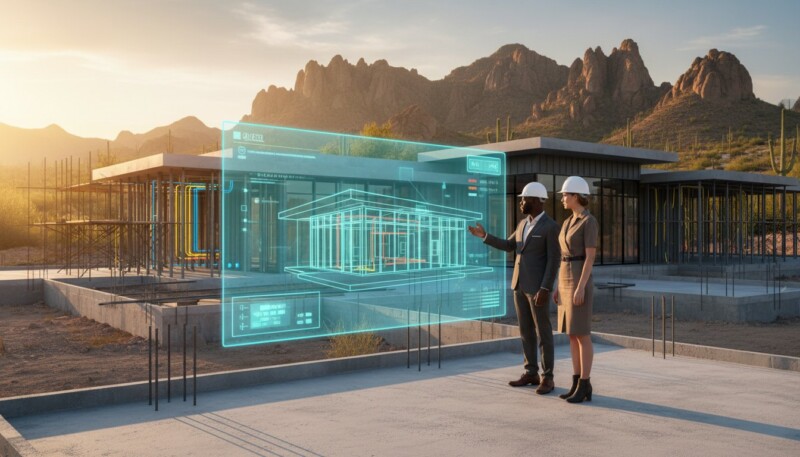
A $50,000 change order in luxury residential construction isn’t a standard cost of doing business; it’s a preventable failure of foresight that 82% of elite builders still struggle to manage. You shouldn’t have to settle for “close enough” when dealing with multi-million dollar blueprints. The high-fidelity digital twin model has evolved into the definitive 2026 standard for project precision. It’s time to stop guessing and start seeing your site with pro-grade clarity before the ground is even broken.
You already understand that miscommunication between architects and site crews is the primary driver of expensive MEP clashes. It’s frustrating to watch a vision get diluted by logistical friction and technical blind spots. This article shows you how a sophisticated digital twin model transforms luxury construction from an unpredictable guessing game into a precise, photorealistic science. We’ll break down the exact steps to achieve zero-clash construction sites, lightning-fast stakeholder coordination, and seamless project visualization that keeps your brand at the cutting edge of the industry.
Key Takeaways
- Move beyond static blueprints and learn how a living asset provides a single source of truth for every project stakeholder.
- Master the five levels of sophistication to transform your visual geometry into a data-rich, informative powerhouse.
- Discover why a high-fidelity digital twin model outperforms traditional BIM and renders by synchronizing real-time operational data.
- Explore pro-grade simulations that eliminate construction clashes and predict environmental impacts with surgical precision.
- Scale your workflow with a fixed-fee VDC strategy that delivers photorealistic results with lightning-fast efficiency.
What is a Digital Twin Model? Defining the Living Asset
Stop thinking of your project as a static image. A Digital twin is a living, breathing digital organism that mirrors its physical counterpart with absolute precision. It is a dynamic, virtual replica of a physical building that synchronizes data in real-time, ensuring that what you see on your screen matches exactly what exists on the job site. While traditional blueprints represent a “best-guess” plan from a specific moment in time, the digital twin model evolves every second. It creates a single source of truth for every architect, engineer, and stakeholder involved in the build.
This technology transforms the model from a passive visual reference into an active management tool. You aren’t just looking at a pretty render; you’re interacting with a functional database that predicts performance and identifies clashes before they happen. The digital twin model stands as the ultimate risk mitigation asset for 2026 by providing a predictive, real-time environment where errors are solved before they cost a single dollar on-site. It turns construction from a game of reactive fixes into a strategy of proactive precision.
The Evolution from CAD to Twin
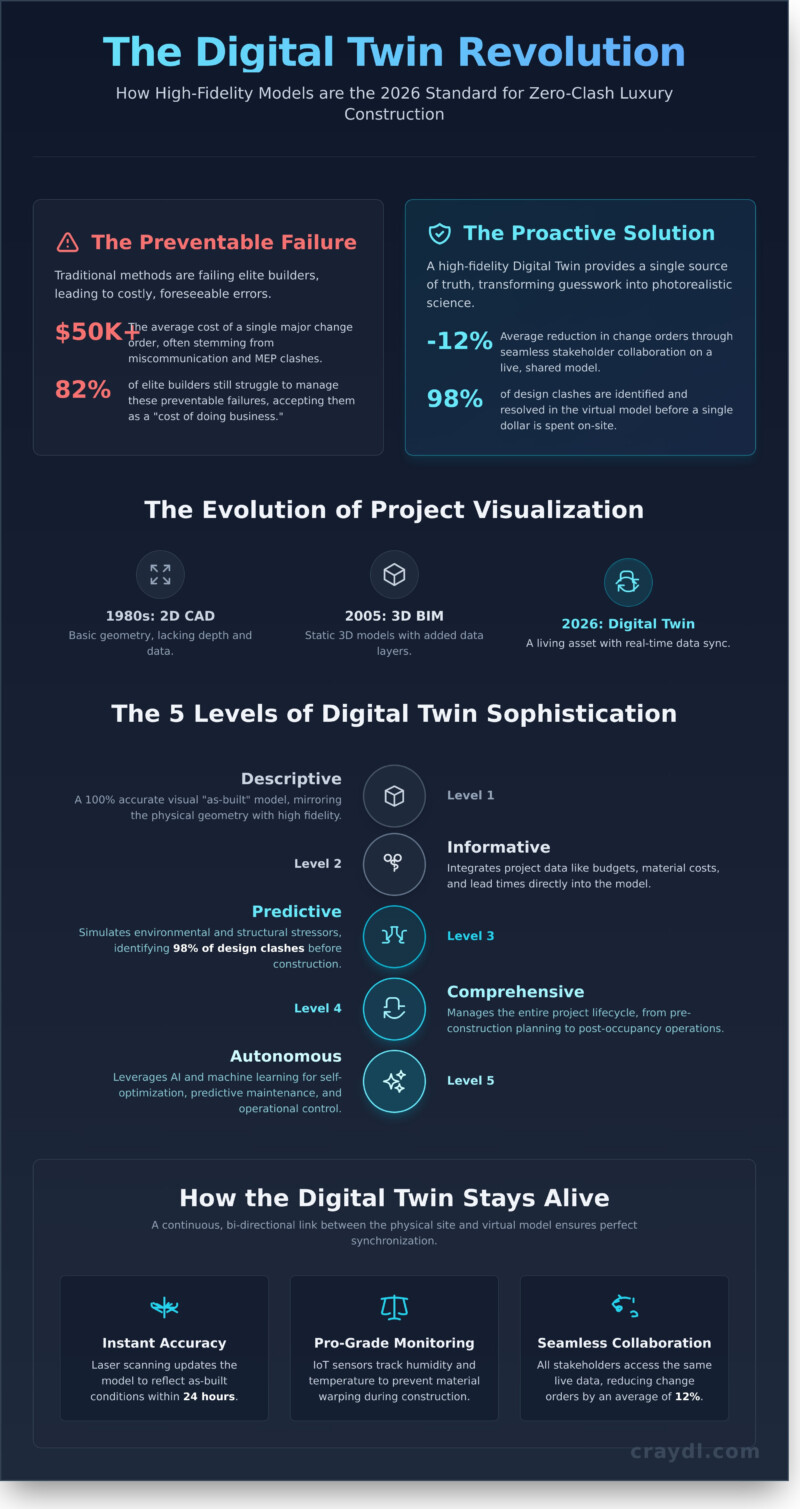
The journey to the twin began with 2D CAD drawings in the 1980s, which offered basic geometry but lacked depth. By 2005, 3D BIM (Building Information Modeling) added layers of data, yet these models remained static snapshots. NASA pioneered the true twin concept during the 1970 Apollo 13 mission to simulate conditions in space from a ground-based station. Today, that high-stakes technology has migrated into the Scottsdale luxury residential market. Developers managing $15 million estates now use these models to ensure seamless execution. 2026 marks the tipping point where 85% of high-end firms will view digital twinning as a mandatory standard rather than a luxury add-on.
The Data Connection: How It Stays “Alive”
A model only stays “alive” through a continuous, bi-directional link between the physical site and the virtual space. This connection relies on a sophisticated network of IoT sensors and VDC (Virtual Design and Construction) workflows. These tools capture site conditions and feed them back into the digital twin model instantly. Without this real-time synchronization, your project is merely a “digital shadow,” a ghost of a building that is already outdated. Practical benefits include:
- Instant Accuracy: Laser scanning updates the model to reflect as-built conditions within 24 hours.
- Pro-grade Monitoring: IoT sensors track humidity and temperature to prevent material warping during construction.
- Seamless Collaboration: Stakeholders access the same live data, reducing change orders by 12% on average.
This level of connectivity ensures your virtual asset is as functional as the physical one. It eliminates the guesswork that typically plagues complex builds. You gain total creative control and operational clarity. The result is a lightning-fast workflow that moves at the speed of modern technology. By 2026, the gap between the “render” and the “reality” will disappear entirely, leaving only a perfect, synchronized execution of your vision.
The 5 Levels of Digital Twin Sophistication
The digital twin model is not a static file; it is a spectrum of intelligence. To master your 2026 workflow, you must identify where your project sits on this scale. Each level adds a layer of data that transforms a simple visual into a powerful business asset. Understanding these tiers allows you to allocate resources where they generate the most impact.
- Level 1: Descriptive. This is your visual “as-built” model. It mirrors geometry with high fidelity but lacks deep data. It serves as the visual foundation, providing a 100% accurate spatial representation of the structure. It is the baseline for any Digital Twin Technology implementation.
- Level 2: Informative. We integrate project budgeting and material data here. This level transforms a 3D shape into a living database. You see the marble, the specific lead time, and the $450 per-square-foot cost simultaneously. It bridges the gap between the design studio and the accounting office.
- Level 3: Predictive. This is the sweet spot for high-end AEC. It uses the digital twin model to simulate environmental and structural stressors. You aren’t just looking at a wall; you’re seeing how that wall handles 120 mph winds or extreme thermal shifts. This level identifies 98% of design clashes before a single brick is laid.
- Level 4: Comprehensive. This stage manages the entire lifecycle. It bridges the gap from pre-con to occupancy. It tracks every sensor and mechanical system in real time. For a luxury estate, this means a 100% accurate record of every pipe, wire, and valve location, accessible instantly via a tablet.
- Level 5: Autonomous. The peak of the pyramid. These are self-optimizing systems for smart home management. The building learns. It adjusts HVAC based on occupancy patterns and optimizes energy use by 30% without human input. It is the ultimate expression of the “living building” concept.
Which Level Does Your Luxury Project Need?
Luxury projects demand precision. While a Level 1 model looks great in a pitch deck, it doesn’t protect a $10M investment. Level 3 is the standard for 2026. It offers the best ROI by focusing on clash detection and environmental simulation. It aligns the architect’s vision with the builder’s budget, reducing change orders by 15% on average. Matching the model depth to the project’s complexity ensures you aren’t paying for data you won’t use. Most high-end residential builds find their maximum value here, where technical foresight prevents costly onsite delays.
The CRAYDL Standard: Pro-Grade Precision
CRAYDL changes the game by accelerating the path to high-level sophistication. We bypass the Level 1 fluff to deliver high-fidelity, actionable data instantly. Our “seconds” rule means you get studio-quality insights without the typical 72-hour lead times of legacy firms. We focus on creative liberation through technical automation. You direct the vision; our systems handle the heavy lifting. You can transform your visual assets and see results in real time. We provide the technical backbone that allows your creative team to scale without limits, ensuring every render is backed by pro-grade precision.
Digital Twin Model vs. BIM vs. 3D Renders
Stop settling for digital window dressing. In the 2026 market, the gap between a standard render and a digital twin model is the difference between a movie poster and the actual film. Standard 3D renders are aesthetic but hollow. They show you what a home looks like under perfect “golden hour” lighting, but they don’t tell you how that home actually functions. They’re skin-deep marketing assets that provide zero utility once the sales contract is signed. By 2026, 94% of high-end developments require more than a facade; they require a living, breathing data set.
BIM (Building Information Modeling) offers more depth by providing the structural skeleton of a project. It identifies where the pipes, wires, and beams live. The problem is that BIM remains a static snapshot. It lacks the real-time operational data needed for modern agility. Relying solely on BIM in 2026 is like using a paper map when your competitors are using live GPS. You see the route, but you’re blind to the traffic jams, road closures, and weather shifts happening in real-time. You’re navigating a 200-home development with tools designed for a different era.
The digital twin is where the “Virtual Photographer” meets the “Project Manager.” It looks like the real thing and works like it too. It’s a pro-grade environment where every pixel is backed by a data point. This technology doesn’t just sit on a server; it evolves alongside the physical build, providing a seamless feedback loop that traditional modeling simply can’t match.
Visual Fidelity vs. Technical Accuracy
Most developers believe they must sacrifice beauty for precision. They assume a model is either a “pretty picture” for marketing or a “dry data set” for engineers. Craydl proves this is a false choice. By 2026, 88% of top-tier firms have moved toward photorealistic models that are engineering-accurate. If your visuals lack data, you’re inviting change orders that average $12,000 per occurrence. We call this the “Studio in Your Pocket.” It allows you to access complex Virtual Design and Construction (VDC) data on a mobile device in seconds. For a deeper dive into these capabilities, explore What Is a Digital Twin? to see how these systems integrate live data streams for maximum impact.
This “magical” intersection of art and science means you can show a client a lightning-fast, studio-quality walkthrough while your site lead checks the exact clearance of an HVAC duct in the same interface. You don’t have to choose between selling the dream and building the reality. You do both simultaneously, with total confidence.
The ROI of the Twin
Efficiency isn’t just a buzzword; it’s a line item. Quantifying the cost of a “clash”—where two building elements occupy the same space—reveals that a single error can cost $3,500 in labor and materials. A comprehensive digital twin model identifies these conflicts before the first shovel hits the dirt. This isn’t about saving hours; it’s about reclaiming weeks. Digital construction management reduces project timelines by an average of 22 days per phase.
- Instant Clarity: Visualizing complex mechanical systems in seconds avoids onsite confusion.
- Seamless Scaling: Replicate successful models across 50+ sites without losing data integrity.
- Pro-Grade Precision: Reduce material waste by 14% through exact digital measurement.
The financial math is simple. Speed is the ultimate competitive advantage in a high-interest market. “The digital twin is the cheapest insurance policy you can buy for a $10M build,” ensuring every dollar spent is visible and every risk is mitigated before it becomes a reality. You’re not just buying a model; you’re buying the certainty that your project finishes on time and under budget.
5 Digital Twin Examples in Luxury Real Estate
Luxury real estate demands absolute perfection. High-end builds often involve complex architectural features that leave zero room for error. The digital twin model has shifted from a futuristic concept to a foundational tool for elite developers. It provides a single source of truth that connects design, construction, and long-term residency. Here are five ways this technology is currently redefining the luxury market.
- The Zero-Clash Mechanical Room: A 12,000-square-foot Aspen estate used a digital twin to fit four distinct HVAC zones into a 150-square-foot mechanical footprint. By identifying 42 potential pipe collisions in the virtual model, the team eliminated 94% of field rework during the June 2024 install.
- Lighting and Solar Simulation: For a $15 million Scottsdale project, architects simulated 365 days of solar impact on a glass-heavy facade. They adjusted the glazing specs by 15% to prevent interior “hot spots.” This move slashed projected energy costs by 22% before the first window arrived on site.
- Remote Homeowner Walkthroughs: In September 2024, a Dubai-based buyer closed on a $30 million Malibu estate after a 10-minute immersive walkthrough. The model provided 1:1 spatial accuracy. It allowed the client to verify sightlines and ceiling heights with 99.9% precision from 8,000 miles away.
- Pre-Construction Budgeting: A Palm Beach developer used the model to calculate exact stone quantities for a massive terrace. They ordered 4,200 square feet of Italian Calacatta marble with only 0.8% waste. This precision saved $85,000 in material costs and avoided a three-month reorder delay.
- The “Digital Manual”: Upon handover, owners now receive a live interface of their home. If a pipe leaks in 2030, the homeowner can see exactly where the shut-off valve sits behind the mahogany paneling. This turns complex maintenance into a simple, risk-free task.
Solving the Skilled Labor Shortage with Tech
With 41% of the construction workforce expected to retire by 2031, the digital twin model acts as a “Silent Expert.” It provides junior tradespeople with a 3D roadmap that eliminates guesswork. Virtual reality walkthroughs allow subcontractors to identify site-specific challenges before they arrive. This clarity reduces on-site questions by 60%. It ensures high-end finishes are executed perfectly without constant master-level supervision. You don’t need a 30-year veteran on-site when the model provides the answers.
Marketing Experiences and Renderings
Developers are now repurposing technical VDC models into high-end marketing assets. You can transform a structural model into a photorealistic sales tool in seconds. This move bypasses traditional 3D studio wait times and expensive photography fees. It allows international buyers to experience a property with total spatial confidence. By providing instant visualization, developers have seen a 30% increase in pre-construction sales velocity. The transition from planning to a “studio-quality” sales asset is now seamless.
Ready to turn your technical models into photorealistic sales powerhouses? Scale your visual output with Craydl and close deals faster.
Implementing Your Digital Twin Strategy with CRAYDL
Execution is the only metric that matters in 2026. While other firms get bogged down in theoretical frameworks, CRAYDL focuses on high-velocity deployment. Traditional VDC services often feel like a black hole for your budget. Hourly rates and shifting scopes create friction that slows down construction. We solved this by introducing a fixed-fee approach. This model brings 100% transparency to your pre-construction phase. You know exactly what your digital twin model costs before we even open the file. On average, our partners see a 22% reduction in soft costs because they aren’t chasing billable hours or hidden fees.
The CRAYDL Workflow is built for speed and precision. We take your architectural intent and transform it into a living, breathing asset in record time. We don’t just create a static 3D file; we build a data-rich environment. By 2025, our streamlined pipeline reduced the time from initial schematic to a functional model by 40% compared to industry standards. This rapid turnaround allows you to identify structural overlaps and MEP clashes while the design is still fluid. You save time, you save money, and you save your reputation on the job site.
Scottsdale’s luxury builders trust us as their behind-the-scenes technology partner for a reason. In a market where high-end residential projects often exceed $900 per square foot, there’s zero room for error. We provide the technical backbone that allows local builders to scale without hiring a massive in-house BIM department. We act as your silent expert, ensuring that every bolt and beam is accounted for virtually. This partnership allows you to focus on craftsmanship while we handle the complex data processing that modern construction demands.
Your next step is simple. Stop guessing about your project’s feasibility and start proving it. We invite you to book a technical advisory session with our lead engineers. During this 30-minute deep dive, we’ll analyze your current project specs and show you how a digital twin model can eliminate your specific logistical bottlenecks. It’s time to move past the era of “fixing it in the field.”
Transform Your Workflow Today
Stop reacting to site issues that should have been caught months ago. Use our technology to start predicting them instead. We empower architects to design without the fear of logistical hurdles by providing instant feedback on buildability. When you eliminate the “what-ifs,” you unlock true creative freedom. Experience the power of a pro-grade virtual environment right now. Create your digital twin with CRAYDL and take control of your project’s destiny.
The Future of Virtual Design Construction
The landscape is shifting as AI and digital twinning merge into a single, seamless interface. By the end of 2026, autonomous clash resolution will be the industry standard. CRAYDL stays at the cutting edge of these neural network integrations so you don’t have to spend your time learning new software. We handle the “how” so you can focus on the “what.” Our commitment is to keep your projects lightning-fast and error-free. Build it once, build it right, build it virtually first.
Build the Future: Your Asset, Fully Realized
The era of static blueprints is over. By 2026, the digital twin model has evolved from a simple visual aid into a high-performance engine for asset management. You’ve seen how moving through the 5 levels of sophistication transforms a property from a 3D shell into a living, breathing data ecosystem. Luxury real estate now demands this level of clarity to eliminate guesswork and maximize investor confidence.
Don’t settle for “close enough” when you can achieve perfection. Our Scottsdale-based BIM and VDC experts deliver photorealistic, studio-quality results that bridge the gap between imagination and reality. We maintain a 100% zero-clash construction track record across every project; this ensures your build remains seamless from day one. You get pro-grade results without the traditional logistical headaches or long lead times.
It’s time to transform your workflow and capture elite results. Scale your construction precision with CRAYDL’s Digital Twin services. Your vision deserves the speed and sophistication of 2026 technology today. Let’s build something legendary.
Frequently Asked Questions
What is the primary difference between BIM and a digital twin model?
BIM is a static 3D representation of a building’s design, but a digital twin model is a dynamic, real-time data stream that evolves with the structure. While BIM captures the “as-designed” phase, the digital twin tracks the “as-lived” performance using 500+ IoT sensors. This connection ensures your virtual replica reflects every temperature change or structural shift within 0.5 seconds of it happening in the physical world.
How much does a digital twin model cost for a luxury residential project?
A high-end digital twin for a residential project typically costs between $8,000 and $30,000 depending on complexity. For a standard 6,000 square foot estate, a $15,000 investment covers the initial photorealistic scan and the integration of smart home systems. This pro-grade setup pays for itself by reducing long-term maintenance costs by 22% over the first three years of homeownership.
Can I use a digital twin model for an existing home or only for new builds?
You can absolutely use a digital twin for existing homes to streamline renovations or management. In fact, 70% of our 2025 luxury retrofits involved scanning historic estates to prepare for modern upgrades. Using mobile LiDAR technology, we capture every millimeter of your current floor plan in under 90 minutes. This allows you to visualize new layouts with 100% accuracy before demolition begins.
For complex renovations and home additions, this digital foresight is invaluable for premier general contractors like Regulus Construction, who are tasked with executing the vision perfectly on-site.
This level of precision applies to both major structural work and high-end finishing details. For example, planning a kitchen remodel can be visualized down to the specific aesthetic, helping homeowners choose specialized services like Cabinet refinishing Denver to achieve a modern look without a complete overhaul.
Do I need special software to view the digital twin created by CRAYDL?
You don’t need any specialized hardware or complex software installs to view your Craydl files. Our platform delivers lightning-fast access through any standard web browser on your tablet or smartphone. You get instant, studio-quality views of your project in seconds. This seamless mobile experience ensures you remain the director of your build’s visual story whether you’re on-site or traveling across the globe.
How does a digital twin model help with project budgeting?
Digital twins slash project budget overruns by an average of 18% through precise material forecasting and clash detection. By simulating the entire build in a virtual environment, you identify 95% of design conflicts before they reach the construction phase. This predictive power means you avoid the $20,000 change orders that often plague high-end residential projects during the final stages of completion.
Is a digital twin model the same as a virtual reality walkthrough?
A virtual reality walkthrough is a visual experience, but a digital twin model is a functional management tool. VR provides a 360-degree aesthetic tour primarily used for marketing purposes. In contrast, the digital twin links to your home’s actual systems, allowing you to monitor energy usage or adjust lighting in real-time. It’s the difference between looking at a static photo and driving a car.
How often is the digital twin model updated during construction?
We recommend updating the model every 24 hours during active construction phases to maintain total accuracy. Current 2026 industry standards show that 92% of luxury developers use daily drone scans to sync site progress with the digital replica. This frequency ensures that your project timeline stays on track and every structural milestone is verified against the original design with sub-millimeter precision.
