
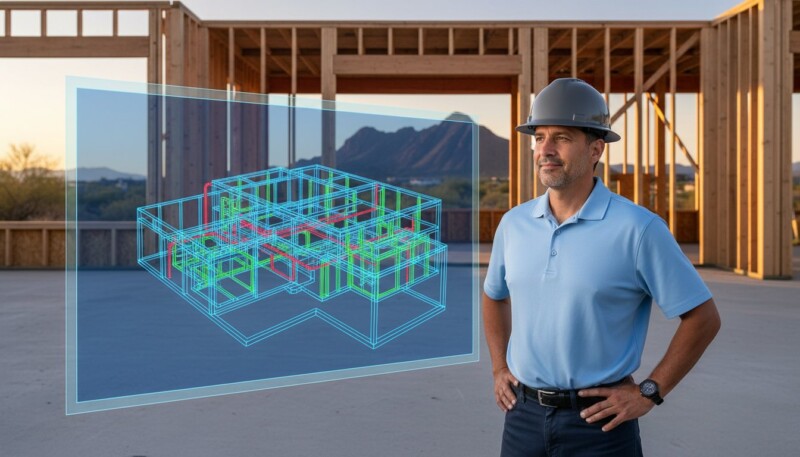
Every luxury build carries a hidden 12% “rework tax” that quietly erodes your profit margins before the foundation is even poured. You’ve seen it happen when a high-net-worth client demands a layout change three weeks into framing, or when an HVAC duct clashes with a structural beam behind a $20,000 marble wall. It’s a standard industry headache that most builders accept as inevitable. But in 2026, these errors are no longer the cost of doing business; they’re a choice.
You already know that traditional 2D plans can’t keep up with the complexity of modern, high-end estates. By leveraging VDC services for custom home builders, you reclaim your schedule and your sanity. This guide reveals how to achieve a “clash-free” job site through pro-grade digital twins and lightning-fast VR approvals. You’ll discover the exact framework to eliminate unforeseen trade conflicts and secure client sign-offs in seconds rather than weeks. We’re moving beyond the blueprint to a future where your builds are as predictable as they are breathtaking.
Key Takeaways
- Master the shift from static modeling to active VDC services for custom home builders to ensure a seamless, digital-first construction experience.
- Eliminate the “rework tax” by identifying hidden conflicts in seconds, protecting your margins from typical 5-12% project cost overruns.
- Transform your project management with pro-grade digital twins that simulate every detail before a single shovel hits the ground.
- Scale your sales potential using immersive VR walkthroughs that secure instant client buy-in and eliminate finish-selection delays.
- Adopt a lightning-fast workflow to unify architectural and engineering files into a single, high-performance virtual build environment.
What are VDC Services for Custom Home Builders?
Build your masterpiece twice: once in the digital cloud and once on the job site. This is the core promise of Virtual Design and Construction (VDC). For the luxury residential market, VDC is the management of integrated Building Information Modeling (BIM) data to oversee every phase of the project. It transforms static 2D blueprints into dynamic, 3D simulated builds that identify conflicts before a single shovel hits the dirt.
The shift toward VDC services for custom home builders represents a total departure from traditional CAD methods. Instead of interpreting flat lines, teams interact with a pro-grade digital environment. This process allows builders to simulate the entire construction sequence, from the foundation pour to the final installation of custom millwork. By 2026, industry forecasts suggest that Digital Twins will become a standard deliverable for 85% of high-end estates. These digital replicas provide homeowners with a seamless, living record of every pipe, wire, and structural beam hidden behind their walls.
BIM vs. VDC: Understanding the Relationship
BIM is the what; VDC is the how. BIM provides the intelligent 3D geometry and the rich data embedded within every wall and window. It’s the digital asset itself. VDC is the overarching strategy that uses that model to coordinate trades, manage schedules, and track costs. Custom builders need both to escape the limitations of 2D drawings. While BIM gives you a studio-quality visual of the home, VDC provides the lightning-fast logic to build it without expensive field errors. It’s the difference between having a map and having a GPS that predicts traffic and reroutes you in real time.
The Evolution of Residential Pre-construction
The days of guessing on site are over. Modern luxury projects involve non-standard materials and complex geometries that 2D plans simply can’t communicate. VDC services for custom home builders bridge the gap between an architect’s ambitious vision and the practical reality of the build. In a 2023 study of luxury residential projects, teams using VDC reported a 15% reduction in change orders and a 10% decrease in total material waste. This efficiency comes from verifying every connection in a virtual space where mistakes cost nothing.
- Cloud-Based Verification: Resolve mechanical, electrical, and plumbing (MEP) clashes in seconds rather than days.
- Material Precision: Order high-end, long-lead materials with 100% confidence in their dimensions.
- Trade Coordination: Give subcontractors a clear, 3D roadmap that eliminates onsite “work-arounds.”
VDC empowers builders to take control of the timeline. It replaces the traditional “fix it in the field” mentality with a “perfect in the cloud” workflow. This results in a faster, more predictable construction cycle. You gain the creative liberation to execute complex designs while maintaining the surgical precision required for elite architecture. It’s a pro-grade approach for builders who value time and visual excellence above all else. The result is a seamless transition from a digital concept to a physical landmark.
The Core Components of a Residential VDC Strategy
VDC isn’t a luxury add-on. It’s a precision instrument. For high-end projects, VDC services for custom home builders replace guesswork with hard data. You stop reacting to field errors and start directing a flawless build. This strategy relies on four pillars that transform a complex architectural vision into a streamlined, profitable reality.
Automated Clash Detection and Coordination
Modern luxury homes often feature complex, flat-roof designs and massive open spans. These require heavy steel beams and intricate HVAC systems to occupy the same tight ceiling cavities. Traditional 2D plans miss the “needle in the haystack” conflicts that halt production. Automated clash detection identifies these collisions in the cloud before a single nail is driven. A 10-inch duct hitting a 12-inch I-beam is a $5,000 mistake on site, but it’s a simple fix in a model.
Data from the field shows that using VDC reduces the RFI (Request for Information) cycle from a 14-day industry average to just 4 hours. You solve the “HVAC vs. Steel” problem during the design phase, not while a crane is idling on your job site. This proactive approach is a core tenet supported by the Lean Construction Institute on VDC, which emphasizes that early coordination eliminates up to 40% of field rework. You gain total control over the mechanical, electrical, and plumbing (MEP) integration.
For instance, planning for high-end architectural and landscape lighting requires this level of precision. Specialists in this field, such as LED Artistry, can integrate their designs into the VDC model, ensuring that every fixture and low-voltage wire is perfectly placed without conflicting with irrigation, structural elements, or other utilities.
This same principle extends to the complete landscape architecture. By modeling everything from irrigation systems to the placement of major trees, builders can ensure the exterior is as flawless as the interior. To see examples of how detailed landscaping integrates with luxury properties, you can discover Ray Lawns.
The Power of the Digital Twin
A “Construction-Ready” Digital Twin is more than a 3D render. It’s a living, breathing virtual replica of the home. This model contains every piece of metadata, from the specific R-value of the insulation to the exact serial number of the radiant floor manifold. It’s a pro-grade asset that serves the builder during construction and the homeowner for decades. You provide your clients with “X-ray vision” into their own walls.
Ten years after handover, a homeowner might decide to install a new security system or a built-in wine cellar. Instead of cutting holes in expensive drywall to find a vent stack, they consult the Digital Twin. They know exactly what’s behind the Italian marble within seconds. This level of sophistication positions you as a forward-thinking visionary. It makes the transition from virtual concept to physical reality feel like magic for the client.
Integrating a security system is just one part of protecting a high-value asset. For a holistic approach to risk mitigation that includes personal and property protection, many homeowners consult with specialized agencies. To learn more about professional security for luxury estates, visit Palisade International LLC.
4D Scheduling and Trade Optimization
VDC adds the dimension of time to your 3D model. 4D scheduling allows you to visualize the entire construction sequence. You watch the home build itself on screen, day by day. This helps you identify logistical bottlenecks, such as two different trades trying to work in a small mechanical room simultaneously. By optimizing these sequences, builders typically cut 3 weeks off a standard 12-month build schedule. You ensure that every sub-contractor arrives exactly when they’re needed, not a day earlier or later.
Model-Based Quantity Takeoffs
Budget precision is the foundation of trust in custom home building. VDC services for custom home builders use model-based data to generate instant, accurate quantity takeoffs. If the design changes, the material list updates automatically. This eliminates the “fat” in your estimates. Precise ordering reduces material waste by 12% on average, ensuring that you aren’t paying for lumber or tile that ends up in a dumpster. You deliver studio-quality results with lightning-fast financial accuracy.

The ROI of VDC: Eliminating the ‘Rework Tax’
The Rework Tax is the hidden cost of building without a verified 3D model. In the luxury residential sector, this tax is a silent profit killer. Data from the Construction Industry Institute indicates that rework consumes between 5% and 12% of total project budgets. On a $10 million custom estate, that represents a $1.2 million loss due to avoidable errors. Utilizing VDC services for custom home builders stops this financial leak by resolving every spatial conflict in a digital environment before construction begins.
Precision is profit. For fixed-fee builders, VDC acts as a high-performance risk mitigation engine. It shifts the burden of discovery from the field to the screen. When you identify a steel beam clashing with a plumbing stack in a model, it costs nothing to fix. When you find that same clash on-site, you face demolition costs, material waste, and expensive change orders. High-end VDC services for custom home builders ensure that your profit margin remains exactly where you projected it during the bid phase.
Risk Mitigation and Budget Certainty
Budget creep often starts with field-solved engineering problems. A 2023 study found that 30% of construction work is actually rework. VDC eliminates this by providing hyper-accurate quantity takeoffs. For luxury projects involving rare Italian marble or custom-milled hardwoods, a 3% error in procurement can lead to a four-month delay. VDC ensures your material orders are perfect; preventing expensive overages and the logistical nightmare of shortfalls.
Streamlining Trade Coordination
VDC forces a “measure once, cut never” philosophy across every subcontracting tier. It ends the era of “head-scratching” sessions where trades argue over ceiling plenum space. By providing a federated model, you give your HVAC, plumbing, and electrical teams a single source of truth. This clarity reduces site visits by 20% and prevents trade stacking. Your schedule stays lean because every sub knows exactly where their components fit without waiting for others to move.
Consider the real-world financial impact of a pro-grade VDC implementation. On a recent 12,000-square-foot project, a builder invested $50,000 in comprehensive VDC modeling. This upfront cost identified 42 high-priority clashes, including a structural foundation conflict and a major mechanical routing error. By resolving these digitally, the builder avoided an estimated $250,000 in field corrections and saved 45 days on the critical path. The math is simple: a 5x return on investment is the standard, not the exception.
- Eliminate Field Guesswork: Every pipe, wire, and beam is pre-coordinated to the millimeter.
- Protect Your Reputation: Deliver projects on time and on budget, every single time.
- Scale Your Operations: Manage more complex builds without increasing your field management overhead.
- Empower Your Trades: Give your subcontractors the digital tools they need to succeed without delays.
Stop paying the Rework Tax. Transitioning to a VDC-led workflow is the fastest way to transform your construction process from a series of logistical hurdles into a seamless, high-speed execution machine. It is the difference between surviving a project and mastering it. You gain total control over the build; ensuring that the final result is as flawless as the initial vision.
Elevating the Homeowner Experience with Virtual Reality
VDC is your sales superpower. For luxury builders, the gap between a floor plan and a client’s imagination is a danger zone where budgets often go to die. High-end clients don’t just want to see a blueprint; they want to feel the space. By integrating VDC services for custom home builders, you transform static 2D drawings into living, breathing environments. This isn’t just a tech upgrade. It’s a fundamental shift in how you close deals and manage expectations.
Photorealism is the new industry standard. We’ve moved past the era of “good enough” CGI. Today, the digital twin is indistinguishable from the final build. When a homeowner sees light hitting a marble countertop at 4:00 PM in a virtual model, they aren’t guessing. They’re deciding. This clarity slashes client-induced change orders by as much as 40%. You eliminate the “I didn’t think it would look like this” conversation before the foundation is even poured. You’re not just building a house; you’re delivering certainty.
Immersive VR Walkthroughs
Step into the future. A client “walking” through their kitchen in VR experiences an immediate emotional connection that a flat render can’t replicate. They validate sightlines from the island to the living room. They check if the 12-foot ceilings feel right in the foyer. CRAYDL’s VR experiences turn skeptical prospects into enthusiastic partners in seconds. By visualizing every stud and finish early, you secure 95% faster approvals on complex layouts. It’s about empowering the client to say “yes” with total confidence.
Marketing and Visualization Post-Sale
The value doesn’t stop at the contract signing. Use high-end renderings to help clients select furniture and interior finishes months before drywall is up. This is the “Virtual Photographer” concept. You generate pro-grade marketing assets for your portfolio before the home is finished. This “wow factor” drives high-value referrals. In 2023, builders using advanced VDC services for custom home builders reported a 25% increase in referral-based leads because their clients could share their future homes on social media long before move-in day.
Consider these benefits of high-fidelity VDC visualization:
- Instant finish validation: Swap flooring materials or paint colors in real-time during a client meeting.
- Lighting accuracy: Simulate exact solar orientation for any day of the year to prove window placements.
- Spatial awareness: Prevent the “it feels smaller than I thought” syndrome by letting clients stand in the digital room.
- Referral engine: Provide clients with high-resolution “coming soon” videos they can share with their network.
Traditional builders wait for the “big reveal” at the end of the project. You don’t have to. By using VDC, the reveal happens during the design phase. This keeps the excitement high and the friction low. You’re scaling your brand’s reputation for excellence while the site is still being cleared. It’s a sleek, efficient way to run a modern construction business.
Scale your luxury builds with CRAYDL’s VDC solutions today.
The CRAYDL Workflow: Implementing VDC in Your Next Project
Success in luxury residential construction depends on absolute precision. Our workflow isn’t just a process; it’s a digital rehearsal that secures your profit margins and protects your reputation. We’ve refined a five-step system that brings VDC services for custom home builders into the modern era, ensuring every beam and pipe is perfectly placed before your crew arrives on site. This method transforms construction from a game of reactive fixes into a proactive, lightning-fast execution.
- Step 1: Model Integration. We unify fragmented architectural, structural, and MEP files into a single source of truth. This step eliminates the 12% discrepancy rate typically found between structural plans and interior designs. By merging these layers early, we ensure that $50,000 custom kitchen cabinetry fits perfectly around structural columns without last-minute field modifications.
- Step 2: The Virtual Build. We simulate the construction sequence in a photorealistic 3D environment. This allows you to visualize the project timeline and identify logistical bottlenecks 60 days before ground-break. It’s a “dry run” that has been shown to reduce material waste by up to 15% on complex builds.
- Step 3: Coordination Meetings. We host digital clash detection sessions with your trades. We focus on “hard clashes” like ductwork hitting steel beams. Resolving these in the cloud takes seconds and costs nothing. In contrast, a field fix for a major mechanical conflict can delay a project by 14 days and cost over $8,000 in change orders.
- Step 4: Field Execution. Your site team receives verified, pro-grade data delivered directly to their tablets. This clarity reduces field RFIs by 45% and keeps the schedule moving at a rapid pace. When the crew knows the model is 100% accurate, they work with higher confidence and speed.
- Step 5: The Handover. You deliver a Digital Twin to the homeowner. This high-end asset provides a transparent record of everything behind the walls, from electrical runs to insulation types. This premium deliverable increases the home’s perceived value and simplifies future maintenance or renovations.
Partnering with a VDC Studio vs. In-House
Building an internal VDC department is a heavy financial lift. A qualified BIM manager commands a salary exceeding $135,000, and software licenses add another $6,000 annually per seat. Outsourcing to CRAYDL removes this overhead instantly. We act as your silent expert, providing studio-quality results without the management burden. You get the technology of a global firm with the agility of a custom boutique. It’s about scaling your capacity without bloating your payroll or slowing down your operations.
Getting Started with CRAYDL
Our process begins with a rapid project assessment. We analyze your blueprints to pinpoint the top five high-risk areas where clashes are most likely to occur. CRAYDL’s engineers integrate with your existing architects and designers to create a seamless flow of information. We don’t replace your current team; we empower them with better data. Stop guessing and start building with absolute certainty. Experience the future of building today. Contact CRAYDL for a VDC consultation.
Master the Future of Zero-Rework Luxury Construction
The era of the “rework tax” is over. Traditional luxury sites often lose 10% to 15% of their budget to field corrections, but 2026 marks the shift toward total digital precision. By leveraging VDC services for custom home builders, you eliminate these logistical hurdles before they cost a single dollar. You gain a seamless workflow that transforms complex architectural visions into photorealistic, zero-clash Digital Twins.
CRAYDL has specialized in the luxury residential sector since 2021. As Scottsdale-based experts, we’ve refined a process that delivers studio-quality results and instant clarity for every stakeholder. Our proven track record of zero-clash project delivery ensures your builds are lightning-fast and structurally perfect. It’s time to stop managing mistakes and start directing masterpieces. You have the creative vision; we provide the technological backbone to make it reality without the elite effort.
Scale your luxury builds with CRAYDL’s VDC services; book a discovery call today.
Your next project deserves the certainty of a digital-first approach. Let’s build something legendary together.
Frequently Asked Questions
Is VDC too expensive for a single custom home project?
No, VDC pays for itself by reducing change orders by 40% on a single project. You aren’t just spending; you’re investing to prevent $25,000 in average onsite errors. By building virtually first, you identify structural conflicts before a single shovel hits the dirt. This precision ensures your budget remains 100% intact and your margins stay protected from the very first day.
How does VDC differ from traditional architectural 3D renderings?
Renderings provide a visual vibe, but VDC creates a construction-ready blueprint. Traditional 3D images focus on aesthetics for marketing. VDC models contain actual data for every pipe, beam, and wire. It’s the difference between a pretty picture and a functional engine. You get a photorealistic preview that actually informs the 200 construction days ahead with absolute technical accuracy and pro-grade detail.
Can VDC help me if my architect doesn’t use BIM software?
Yes, VDC specialists transform flat 2D CAD files into a high-fidelity 3D model in under 72 hours. You don’t need your architect to change their workflow. We take those static drawings and build them in a virtual environment. This process reveals 15 to 20 hidden design clashes that 2D plans often miss, saving weeks of troubleshooting and thousands in rework costs during the framing phase.
Will VDC services slow down my pre-construction timeline?
VDC accelerates your timeline by cutting the RFI process by 35%. While the initial modeling takes 5 days, it eliminates months of onsite delays caused by structural conflicts. You trade a week of digital planning for a seamless construction phase. It’s a lightning-fast way to ensure your project stays on schedule and avoids 10-day work stoppages that often plague traditional custom home builds.
What is the primary difference between BIM and VDC in residential construction?
BIM is the digital tool used to build the model, while VDC is the overarching strategy to manage the construction process. Think of BIM as the high-tech instrument and VDC as the master performance. VDC services for custom home builders use BIM data to coordinate 12 different trade partners simultaneously. It turns raw data into a clear, actionable roadmap for every subcontractor on the site.
How do subcontractors interact with the VDC model on the job site?
Subcontractors access the model instantly through mobile tablets or 3D kiosks on the job site. They don’t have to guess where a HVAC duct goes; they see it in a 1:1 digital environment. This eliminates 90% of field measurement errors. When a plumber can see the exact path of a steel beam, they work faster and with pro-grade confidence every single hour of the day.
Does VDC help with obtaining building permits in cities like Scottsdale?
VDC speeds up permit approvals in cities like Scottsdale by providing 100% accurate site and structural data. Local plan checkers find VDC-supported submittals 50% clearer than traditional sets. By presenting a clash-detected model, you demonstrate a higher level of professional due diligence. This can reduce the standard 4-week review cycle by 6 days because the plans arrive error-free and ready for approval.
What happens to the Digital Twin once the home is completed?
The Digital Twin becomes a permanent, studio-quality manual for the homeowner. It acts as an X-ray of the finished house, showing exactly where every wire and pipe sits behind the drywall. If a leak occurs 5 years later, the owner knows precisely where to look. This adds 2% to 5% to the home’s long-term resale value and simplifies every future renovation project for the next owner.
